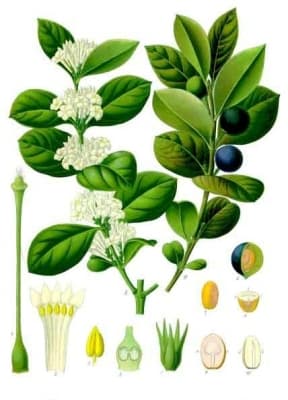
Acokanthera schimperi
Acokanthera schimperi
Safety & Hazards
All parts of the plant, except the pulp of the fully ripe fruit, are highly poisonous[1]. They contain large amounts of cardiac glycosides (cardenolides), of which nearly 20 have been identified[1]. The plant is widely used as an arrow poison in Africa[1]. The only treatment against the poison is immediate excision of the flesh around the wound, or sucking the blood from the wound[1]. Birds have been known to drop dead on sucking nectar from the flowers[2].
Cultivation Details
A plant of moderate elevations in the tropics, it is also found at lower elevations, though this appears to be associated with human introduction[1]. It is found wild at elevations from 1,100 - 2,400 metres[1, 2]. It grows best in areas where annual daytime temperatures are within the range 17 - 23°c, but can tolerate 15 - 28°c[2]. It prefers a mean annual rainfall in the range 500 - 700mm, but tolerates 400 - 1,000mm[2]. Prefers a sunny position in well-drained, red or black rocky soils, but also grows on black cotton soil and poor soil of dry sites[1, 2]. Established plants are drought resistant[1]. Prefers a pH in the range 5.5 - 6.5, tolerating 5 - 7[2]. The plant has a moderate rate of growth[1].
Propagation
Seed - the seeds have high moisture content and lose viability easily under ambient conditions and on storage[1]. Seed germination is low[1]. Cite as: Tropical Plants Database, Ken Fern. tropical.theferns.info. 2026-02-19. <tropical.theferns.info/viewtropical.php?id=Acokanthera+schimperi>
Pollinators
Bees
References
- [1]Protabase - Plant Resources of Tropical Africa. — http://www.prota.org ↩︎An excellent on-line database with detailed information on over 3,200 species of useful plants of Africa.
- [2]Ecocrop — http://ecocrop.fao.org/ecocrop/srv/en/home ↩︎Basic information on a wide range of useful plants, plus details of environmental needs where available.
- [3]Edible Wild Plants of Tanzania — Ruffo, C.K.: Birnie, A. & Tengnas, B. · Regional Land Management Unit; Nairobi. · 2002 · ISBN 9966-896-60-0 ↩︎A very well presented, simple guide to growing and utilizing wild food plants in Tanzania, with line drawings of each plant, a description, habitat and range, non-food as well as food uses, plus basic information on growing the plants.
- [4]World Agroforesty Centre — http://www.worldagroforestry.org/ ↩︎An excellent online database of a huge range of trees giving very good information on each plant - its uses, ecology, identity, propagation, pests etc.