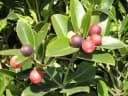
Acokanthera oppositifolia
Acokanthera oppositifolia
Safety & Hazards
All parts of the plant, except the fully ripe fruit, are poisonous[1]. A thick extract, obtained from the cooked roots, bark and leaves of the plant, is used as an arrow poison, which must be handled with care[1]. The only treatment against the poison is immediate excision of the flesh around the wound[2]. Fatal accidents have been caused by eating meat grilled over a fire of sticks from this tree[2]. Contact with the plant can cause smarting of the eyes and skin, and throat irritation[3].
Cultivation Details
A plant of moderate to higher elevations in the drier tropics, where it can be found at elevations from 1,000 - 2,400 metres. It grows best in areas with a mean annual rainfall in the range 600 - 1,000mm[2]. Older plants can resist at least some frost[2]. Often found in open, sunny positions, the plant is also shade tolerant[2]. It thrives in rocky, red clay and clay-loam soils, often being found on termite mounds in the wild[2]. Established plants are drought tolerant[2]. A moderately fast-growing tree[2]. The tree responds well to pruning, coppicing and pollarding[2].
Propagation
Seed - it requires no pre-treatment, but has a very limited viability and so should be sown as soon as it is ripe[2]. Cuttings of half-ripe wood[2]. Cite as: Tropical Plants Database, Ken Fern. tropical.theferns.info. 2026-02-19. <tropical.theferns.info/viewtropical.php?id=Acokanthera+oppositifolia>
Pollinators
Data unavailable
References
- [1]Edible Wild Plants of Tanzania — Ruffo, C.K.: Birnie, A. & Tengnas, B. · Regional Land Management Unit; Nairobi. · 2002 · ISBN 9966-896-60-0 ↩︎A very well presented, simple guide to growing and utilizing wild food plants in Tanzania, with line drawings of each plant, a description, habitat and range, non-food as well as food uses, plus basic information on growing the plants.
- [2]Protabase - Plant Resources of Tropical Africa. — http://www.prota.org ↩︎An excellent on-line database with detailed information on over 3,200 species of useful plants of Africa.
- [3]BoDD (Botanical Dermatology Database) — http://bodd.cf.ac.uk/ ↩︎Brief notes on a very wide range of plants that have reports of causing harm to the skin.
- [PFAF]Plants for a Future — pfaf.org ↩︎