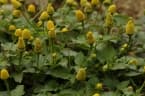
Acmella oleracea
Acmella oleracea
Safety & Hazards
None known
Cultivation Details
Prefers a sunny position[1]. Plants have escaped from cultivation in New Caledonia, where the species is classified as 'Invasive'[2]. There is a wild form with much stronger flavoured leaves that is occasionally used in salads but is more commonly used medicinally, especially to treat toothache[3, PFAF]. A cultivated form 'Oleracea' has milder flavoured leaves and has become very popular in Brazil both as a salad and an addition to soups[3]. It has been suggested that Acmella oleracea was mostly likely derived through cultivation from Acmella alba (L’Hér.) R. K. Jansen in central Peru[4].
Propagation
Seed - requires a temperature of 21°c to germinate[5]. Germination takes place in about 2 weeks[6]. Cuttings when the plant is not in flower[5]. Cite as: Tropical Plants Database, Ken Fern. tropical.theferns.info. 2026-02-19. <tropical.theferns.info/viewtropical.php?id=Acmella+oleracea>
Pollinators
Data unavailable
References
- [1]The New RHS Dictionary of Gardening. 1992. — Huxley. A. · MacMillan Press · 1992 · ISBN 0-333-47494-5 ↩︎Excellent and very comprehensive, though it contains a number of silly mistakes. Readable yet also very detailed.
- [2]Pacific Island Ecosystems at Risk — http://www.hear.org/pier/scientificnames/index.html ↩︎A very good website detailing weed species that have been introduced into the Pacific Islands.
- [3]Cornucopia II — Facciola. S. · Kampong Publications, California. · 1998 · ISBN 0-9628087-2-5 ↩︎The second edition of an excellent guide to the edible uses of plants, though it does not give any details of cultivation etc.
- [4]The Systematics of Acmella (Asteraceae-Heliantheae) — Jansen R.K. · American Society of Plant Taxonomists · 1985 ↩︎
- [5]Protabase - Plant Resources of Tropical Africa. — http://www.prota.org ↩︎An excellent on-line database with detailed information on over 3,200 species of useful plants of Africa.
- [6]Desert Tropicals — http://www.desert-tropicals.com/ ↩︎The main focus of the site is succulent plants, but it also contains information on a wide range of other species. Usually at least one good photograph, plus basic information about the plant and its cultivation.
- [7]Notes on Acmella (Asteraceae: Heliantheae) in Taiwan — Chung K.F. et al · 2008 ↩︎
- [8]Dictionary of Economic Plants. — Uphof. J. C. Th. · Weinheim · 1959 · ISBN - ↩︎An excellent and very comprehensive guide but it only gives very short descriptions of the uses without any details of how to utilize the plants. Not for the casual reader.
- [9]Medicinal Plants of the Guianas — DeFilipps, R. A.; Maina, S. L.; & Crepin, J. · Smithsonian Museum · http://botany.si.edu/bdg/medicinal/index.html ↩︎A down-loadable PDF document of a book in pre-publication awaiting illustration. An excellent, if rather terse, guide to the traditional medicinal uses of the plants of the region
- [10]Flowers of India — http://www.flowersofindia.net/ ↩︎A wed site of native Indian plants, plus cultivated and naturalized species. It has good quality photos and terse details on more than 3,000 species and cultivars.
- [11]Enciclopedia de las Plantas Útiles del Ecuador — de la Torre, L., Navarrete H., P. Muriel M., Macía M.J. & Ba · Herbario QCA de la Escuela de Ciencias Biológicas de la Pontific · 2008 · ISBN 978-9978-77-135-8 ↩︎
- [12]Plants of Possible Insecticidal Value - A Review of the Literature up to 1941 — McIndoo N.E. · USDA; Bureau of Entomology and Plant Quarantine · 1945 ↩︎Information on the insecticidal properties (or not) of almost 1,200 species of plant. Rather dated but still with information hard to obtain elsewhere. It can be downloaded from the Intenet
- [PFAF]Plants for a Future — pfaf.org ↩︎