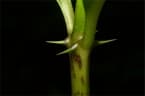
Acanthus ilicifolius
Acanthus ilicifolius
Safety & Hazards
None known
Cultivation Details
A plant of the tropics, where it is found at near the shoreline in areas with no dry season or with a short dryseason. It grows best in areas where annual daytime temperatures are within the range 18 - 26°c, but can tolerate 15 - 32°c[1]. It prefers a mean annual rainfall in the range 1,500 - 2,500mm, but tolerates 1,000 - 3,000mm[1]. Prefers a position in full sun, tolerating some shade[1]. Grows best in heavier soils of moderate to high fertility[1]. Tolerant of flooding and of quite high levels of salt in the soil[1].Prefers a pH in the range 6.8 - 7.2, tolerating 6.5 - 7.5[1]. The plant sometimes forms a dense undergrowth in mangrove swamps that can be troublesome in wood-cutting operations[1]. The plants do not exclude salt at the root level. In fact, their sap is salty and excess salt is secreted through the leaves, to be removed by rain or wind. Sometimes, the salt can be seen as a white crystalline layer on the upper surface[2]. When the seedpods ripen, they open explosively to propel the seeds up to 2 metres away[2].
Propagation
Seed - Cite as: Tropical Plants Database, Ken Fern. tropical.theferns.info. 2026-02-19. <tropical.theferns.info/viewtropical.php?id=Acanthus+ilicifolius>
Pollinators
Data unavailable
References
- [1]Ecocrop — http://ecocrop.fao.org/ecocrop/srv/en/home ↩︎Basic information on a wide range of useful plants, plus details of environmental needs where available.
- [2]Flowers of India — http://www.flowersofindia.net/ ↩︎A wed site of native Indian plants, plus cultivated and naturalized species. It has good quality photos and terse details on more than 3,000 species and cultivars.
- [3]Plant Resources of Southeast Asia — http://proseanet.org/ ↩︎Lots of information on the uses of the plants of SE Asia.
- [4]Medicinal Plants of the Philippines — Bureau of Plant Industry, Philippines. · http://www.bpi.da.gov.ph/Publications/mp/mplants.html ↩︎An Internet site from the Philippines Department of Agriculture, giving information in a readable way on the medicinal uses of many plants in their area.
- [5]Medicinal Plants of East and Southeast Asia; Attributed Properties and Uses — Perry L.M. & Metzger J. · MIT Press; Cambridge, Massachussetts · 1980 · ISBN 0-262-16076-5 ↩︎A monumental work, detailing the traditional medicinal uses of plants from the region