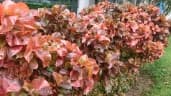
Euphorbiaceae FAMILY
Acalypha wilkesiana
Acalypha wilkesiana
Edibility
2/5
Medicinal
2/5
Safety & Hazards
The bark has been used as a poison[1].
Cultivation Details
HabitEvergreen Shrub
Growth—
Prefers a moist, average to moderately fertile, well-drained soil in full sun to part shade[2]. The best foliage colour is produced when growing in full sun[2]. Soils must be kept consistently moist, if they dry out then rapid leaf drop usually occurs[2]. A widely cultivated ornamental plant, it often escapes from cultivation and has become established in disturbed sites in many areas[3]. In areas without a pronounced dry season the plant can flower and produce fruit all year round[1]. Plant size can be easily controlled by cutting back, or by pinching out the shoot tips to promote bushiness[2].
References
- [1]Plant Resources of Southeast Asia — http://proseanet.org/ ↩︎Lots of information on the uses of the plants of SE Asia.
- [2]KemperCentreForHomeGardeningPlantFinder — Missouri Botanical Garden · http://www.mobot.org/gardeninghelp/plantfinder/ ↩︎Basic cultivation details, plant uses, habitat etc for several thousand species of plants, mainly from the temperate zone.
- [3]National Tropical Botanical Garden — http://ntbg.org/plants/choose_a_plant.php ↩︎General information on almost 400 species, with descriptions, habitats and some uses.
- [4]Medicinal Plants in Papua New Guinea — World Health Organisation · 2009 · ISBN 978-92-9061-249-0 ↩︎Traditional medicinal uses of 126 species from Papua New Guinea, including information on modern research into the plants.
- [5]Revision and phylogeny of Acalypha (Euphorbiaceae) in Malesia — Sagun V.G., Levin G.A. & van Welzen P.C. · 2010 · http://10.3767/000651910X499141 ↩︎
- [6]Medicinal Plants in Nigeria (website) — Professor Tolu Odugbemi · http://www.medicinalplantsinnigeria.com/uploads/1/7/4/8/17482593/plantsdatabase.xls ↩︎An on-line database, downloadable in .xls format, it has basic information on 628 species of plants
- [PFAF]Plants for a Future — pfaf.org ↩︎