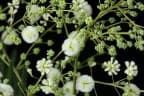
Acaciella angustissima
Acaciella angustissima
Safety & Hazards
Especially in times of drought, many Acacia species can concentrate high levels of the toxin Hydrogen cyanide in their foliage, making them dangerous for herbivores to eat.
Cultivation Details
Fernleaf acacia is a versatile plant that can grow from the warm temperate zone to the tropical zone. It succeeds at elevations from sea level to 2,600 metres, tolerating a mean annual temperature in the range of 5 - 30°c and a mean annual rainfall in the range 895 - 2,870mm[1]. It can tolerate quite cold climates with occasional temperatures falling below freezing[1]. Grows best in a sunny position. Grows well in free-draining, acidic, infertile soils[1]. It is adapted to a wide range of soils including vertisols of slightly alkaline pH[2]. A very drought-tolerant plant, possibly due to its substantial taproot. It can retain its green foliage in dry seasons that can be as long as 8 months[1]. Fernleaf acacia is fast-growing, quick to mature and a prolific seed producer[1]. It flowers throughout the year in its natural range[1]. This ability to grow quickly and reproduce when young has resulted in the plant becoming weedy and forming thickets, especially along roadsides and in sandy soil in pastures in its native range[1]. This weed potential has created concern among some researchers about the advisability of its use in agroforestry or agricultural systems[1]. The plant responds well to regular cutting and to coppicing[1]. This species has a symbiotic relationship with certain soil bacteria, these bacteria form nodules on the roots and fix atmospheric nitrogen. Some of this nitrogen is utilized by the growing plant but some can also be used by other plants growing nearby[3]. When introducing A. Angustissima into a new area it may be necessary to inoculate with an appropriate Rhizobium before planting[1].
Propagation
Seed - germinates best when soaked for 12 hours in cold water prior to sowing[1]. The standard seed treatment for Acacia species (pre-soaking the seed in warm water for 12 hours) results in inferior germination. Scarifying the seed by scratching or nicking the round end of each seed with a file, knife or nail clipper (without damaging the cotyledon) before sowing has also been suggested[1]. Fernleaf acacia seems to fare better when grown from transplanted seedlings than from direct seeding. If it is to be directly seeded, then it is important not to sow too deeply. The seeds should be sown on the surface of cultivated soil and covered with a layer of soil equal to the width of the seed[1]. Cite as: Tropical Plants Database, Ken Fern. tropical.theferns.info. 2026-02-19. <tropical.theferns.info/viewtropical.php?id=Acaciella+angustissima>
Pollinators
Data unavailable
References
- [1]World Agroforesty Centre — http://www.worldagroforestry.org/ ↩︎An excellent online database of a huge range of trees giving very good information on each plant - its uses, ecology, identity, propagation, pests etc.
- [2]Tropical Forages — http://www.tropicalforages.info/key/Forages/Media/Html/index.htm ↩︎Mainly focussed on forage plants, the site gives a lot of information on the plant, with a good botanical description, details of cultivation, plant uses and a good selection of photographs.
- [3]The New RHS Dictionary of Gardening. 1992. — Huxley. A. · MacMillan Press · 1992 · ISBN 0-333-47494-5 ↩︎Excellent and very comprehensive, though it contains a number of silly mistakes. Readable yet also very detailed.
- [4]Flora of Guatemala — Standley P.C. & J. A. Steyermark · 1946 - 1976 · http://www.archive.org/ ↩︎A superb reference, though somewhat dated. Gives lots of plant uses as well as information on plant habit and habitat. The entire flora (13 volumes) can now be downloaded from http://www.archive.org/
- [5]Food Plants in the Americas: A Survey of the Domesticated, Cultivated, and Wild Plants Used for Human Food in North, — Kermath B.M.; Bennett B.C.' Pulsipher L.M. · 2014 ↩︎A pre-publication draft of an amazing, on-going work first started in 1985. It contains information on more than 3,900 taxa from the Americas - from Arctic regions to the Tropics
- [6]Dictionary of Economic Plants. — Uphof. J. C. Th. · Weinheim · 1959 · ISBN - ↩︎An excellent and very comprehensive guide but it only gives very short descriptions of the uses without any details of how to utilize the plants. Not for the casual reader.
- [7]The Useful Native Plants of Australia. — Maiden J.H. · Turner & Co.; London. · 1889 · http://www.biodiversitylibrary.org ↩︎Terse details of the uses of many Australian plants and other species naturalised, or at least growing, in Australia. It can be downloaded from the Internet.
- [PFAF]Plants for a Future — pfaf.org ↩︎