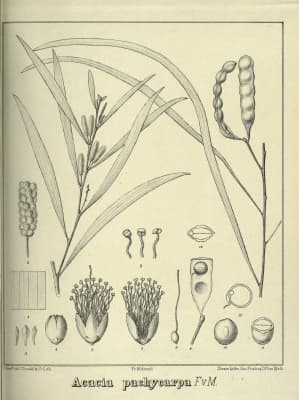
Acacia pachycarpa
Acacia pachycarpa
Safety & Hazards
The seed of many Acacia species, including this one, is edible and highly nutritious, and can be eaten safely as a fairly major part of the diet. Not all species are edible, however, and some can contain moderate levels of toxins[1]. Especially when harvesting from the wild, especial care should be taken to ensure correct identification of any plants harvested for food[PFAF]. Especially in times of drought, many Acacia species can concentrate high levels of the toxin Hydrogen cyanide in their foliage, making them dangerous for herbivores to eat.
Cultivation Details
Acacia pachycarpa is a plant of hot and arid regions in the tropics of northwestern Australia, where it is found at elevations up to 300 metres. It grows best in areas where annual daytime temperatures are within the range 25 - 37°c, but can tolerate 10 - 45°c[2]. It is not tolerant ofany but the lightest frosts[3, 4]. It prefers a mean annual rainfall in the range 225 - 300mm, but tolerates 150 - 350mm[2]. Requires a sunny position[2]. Found in the wild in heavier soils, but is tolerant of a wide range, including sandy[3, 2]. Prefers a pH in the range 6.5 - 7.5, tolerating 6 - 8[2]. Established plants are very drought tolerant[2]. Requires a sunny position. Found on heavy clay soils as well as sands and loams in the wild, and able to tolerate some salt in the soil[4]. A relatively fast-growing tree[4]. The plant is considered to be unsuitable for use as an ornamental because the leaves, branches and flowers have an unpleasant smell[5]. The plant can be coppiced, producing basal shoots and possibly root suckers after fire[4]. This species has a symbiotic relationship with certain soil bacteria; these bacteria form nodules on the roots and fix atmospheric nitrogen. Some of this nitrogen is utilized by the growing plant but some can also be used by other plants growing nearby[3].
Propagation
The seed of most, if not all, members of this genus has a hard seedcoat and may benefit from scarification before sowing to speed up germination. This can usually be done by pouring a small amount of nearly boiling water on the seeds (being careful not to cook them!) and then soaking them for 12 - 24 hours in warm water. By this time they should have imbibed moisture and swollen - if they have not, then carefully make a nick in the seedcoat (being careful not to damage the embryo) and soak for a further 12 hours before sowing. Acacia seeds that have matured fully on the bush and have been properly dried have a hard seed coat and can be stored in closed containers without deterioration for 5 - 10 years or more in dry conditions at ambient temperatures. It is best to remove the aril, which attracts weevils and can lead to moulds forming. The arils are easilyremoved by placing the seeds in water and rubbing them between the hands, then drying the seeds and winnowing them[6]. Cite as: Tropical Plants Database, Ken Fern. tropical.theferns.info. 2026-02-19. <tropical.theferns.info/viewtropical.php?id=Acacia+pachycarpa>
Pollinators
Insects
References
- [1]Acacia in Australia: Ethnobotany and Potential Food Crop — Lister P.R.; Holford P.; Haigh T.; Morrison D.A. · ASHS Press, Alexandria, VA. · 1996 · https://hort.purdue.edu/newcrop/proceedings1996/v3-toc.html · ISBN 0-9615027-3-8 ↩︎
- [2]Ecocrop — http://ecocrop.fao.org/ecocrop/srv/en/home ↩︎Basic information on a wide range of useful plants, plus details of environmental needs where available.
- [3]World Agroforesty Centre — http://www.worldagroforestry.org/ ↩︎An excellent online database of a huge range of trees giving very good information on each plant - its uses, ecology, identity, propagation, pests etc.
- [4]Australian Trees and Shrubs: Species for Land Rehabilitation and Farm Planting in the Tropics — Doran J.C.; Turnbull J.W. (Editors) · Australian Centre for International Agricultural Research; Canbe · 1997 · ISBN 1-86320-127-0 ↩︎A very informative book, rich in information about the uses, cultivation needs and very much more for over 160 species of Australian trees and shrubs.
- [5]IUCN Red List of Threatened Species — http://www.iucnredlist.org/ ↩︎A list of plants under threat and facing possible extinction, usually with brief details of the threats and information on habitat.
- [6]Potential of Australian Acacias in combating hunger in semi-arid lands — Rinaudo A.; Patel P.; Thomson L.A.J. · 2002 ↩︎
- [7]Flora of Australia — http://www.anbg.gov.au/abrs/abif/flora/ ↩︎The full information from the Flora of Australia - on-line. An excellent resource.
- [8]Australian Native Plants Society — http://anpsa.org.au/index.html ↩︎A series of fact sheets on Australian plants. Good photographs, brief description and information on uses, habitat, range, cultivation etc.
- [9]The Useful Native Plants of Australia. — Maiden J.H. · Turner & Co.; London. · 1889 · http://www.biodiversitylibrary.org ↩︎Terse details of the uses of many Australian plants and other species naturalised, or at least growing, in Australia. It can be downloaded from the Internet.
- [PFAF]Plants for a Future — pfaf.org ↩︎