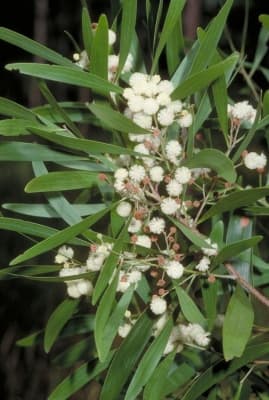
Acacia melanoxylon
Acacia melanoxylon
Safety & Hazards
The wood is an important cause of allergic contact dermatitis in Australia. Quinones such as acamelin and hydroxyflavans such as melacacidin are responsible for the sensitizing activity. Occupational asthma caused by blackwood has also been reported in wood workers[1]. The seed of many Acacia species, including this one, is edible and highly nutritious, and can be eaten safely as a fairly major part of the diet. Not all species are edible, however, and some can contain moderate levels of toxins[2]. Especially when harvesting from the wild, especial care should be taken to ensure correct identification of any plants harvested for food[PFAF]. Especially in times of drought, many Acacia species can concentrate high levels of the toxin Hydrogen cyanide in their foliage, making them dangerous for herbivores to eat.
Cultivation Details
A plant of the warm temperate to subtropical zones, able to be cultivated at higher elevations in the tropics. It shows a wide ecological adaptability in its native Australia. The mean annual temperature in its range is 6 - 19°c. Mature trees can tolerate moderate frost with occasional temperatures down to around -10°c, though young trees are more sensitive[1]. The mean annual rainfall is within the range 750 - 2,300mm[1]. In tropical Africa it is usually planted in comparatively cool and wet upland regions at elevations around 1,500 - 2,500 metres[1]. Requires a sunny position, even as a seedling[1]. Grows best in deep, moist and fertile soils, but also succeeds on a wide range of sandy loams and alluvial soils and in wet, nearly swampy places[3, 1]. Succeeds in a hot dry position[4]. Succeeds in any good garden soil that is not excessively limey[5]. Most members of this genus become chlorotic on limey soils[6]. The tree is fast growing. In plantations in Rwanda during the first 12 years of growth, the increase in height was 1.5 - 2.4 metres per year and in diameter 16 - 19mm per year. In Tanzania 20 year-old planted trees were 25 - 32 metres tall, with a bole diameter of almost 50cm at breast height. Plantation trees in South Africa had a mean diameter increase of 1 - 2cm per year until the trees were 22 years old[1]. A major problem in plantation establishment is that young trees often have poor apical dominance when grown in full light, resulting in large numbers of branches and trees of poor bole form[1]. Trees may commence flowering when just 2 years old. They are usually prolific seed producers[1]. Trees respond well to coppicing, being able to produce new shoots even from old wood[PFAF]. A long-lived species, with ages of over 200 years reported from Australia[1]. This species produces both phyllodes (basically a flattened stem that looks and acts like a leaf) and true leaves[7, 4]. The roots are very vigorous and extensive - they often produce suckers in the wild[8, 9] and can damage the foundations of buildings[6]. This species has a symbiotic relationship with certain soil bacteria, these bacteria form nodules on the roots and fix atmospheric nitrogen. Some of this nitrogen is utilized by the growing plant but some can also be used by other plants growing nearby[6].
Propagation
Seed - best sown as soon as it is ripe in a sunny position in a warm greenhouse[7].The dried seed of most, if not all, members of this genus has a hard seedcoat and may benefit from scarification before sowing to speed up germination. This can usually be done by pouring a small amount of nearly boiling water on the seeds (being careful not to cook them!) and then soaking them for 12 - 24 hours in warm water. By this time they should have imbibed moisture and swollen - if they have not, then carefully make a nick in the seedcoat (being careful not to damage the embryo) and soak for a further 12 hours before sowing. Sow the seed in Spring in a greenhouse. As soon as the seedlings are large enough to handle, prick them out into individual pots and grow them on in a sunny position in the greenhouse for their first winter. Plant them out in late spring or early summer, after the last expected frosts, and consider giving them some protection from the cold for their first winter outdoors. Acacia seeds that have matured fully on the bush and have been properly dried have a hard seed coat and can be stored in closed containers without deterioration for 5 - 10 years or more in dry conditions at ambient temperatures. It is best to remove the aril, which attracts weevils and can lead to moulds forming. The arils are easilyremoved by placing the seeds in water and rubbing them between the hands, then drying the seeds and winnowing them[10]. Cuttings of half-ripe wood with a heel, mid summer in individual pots in a frame[11]. Overwinter in a greenhouse for the first winter and plant out in their permanent positions in late spring or early summer. Fair percentage[11]. Cite as: Temperate Plants Database, Ken Fern. temperate.theferns.info. 2026-02-20. <temperate.theferns.info/plant/Acacia+melanoxylon>
Pollinators
Bees
References
- [1]Protabase - Plant Resources of Tropical Africa. — http://www.prota.org ↩︎An excellent on-line database with detailed information on over 3,200 species of useful plants of Africa.
- [2]Acacia in Australia: Ethnobotany and Potential Food Crop — Lister P.R.; Holford P.; Haigh T.; Morrison D.A. · ASHS Press, Alexandria, VA. · 1996 · https://hort.purdue.edu/newcrop/proceedings1996/v3-toc.html · ISBN 0-9615027-3-8 ↩︎
- [3]A Field Guide to Australian Trees. — Holliday. I. and Hill. R. · Frederick Muller Ltd. · 1974 · ISBN 0-85179-627-3 ↩︎A well illustrated and very readable book, but it does not contain much information for the plant project.
- [4]The Milder Garden. — Taylor. J. · Dent · 1990 ↩︎A good book on plants that you didn't know could be grown outdoors in Britain.
- [5]Trees and Shrubs Hardy in Great Britain. Vol 1 - 4 and Supplement. — Bean. W. · Murray · 1981 · ISBN - ↩︎A classic with a wealth of information on the plants, but poor on pictures.
- [6]The New RHS Dictionary of Gardening. 1992. — Huxley. A. · MacMillan Press · 1992 · ISBN 0-333-47494-5 ↩︎Excellent and very comprehensive, though it contains a number of silly mistakes. Readable yet also very detailed.
- [7]RHS Dictionary of Plants plus Supplement. 1956 — F. Chittendon. · Oxford University Press · 1951 · ISBN - ↩︎Comprehensive listing of species and how to grow them. Somewhat outdated, it has been replaced in 1992 by a new dictionary (see [ 200 ]).
- [8]Conservatory and Indoor Plants Volumes 1 & 2 — Phillips. R. & Rix. M. · Pan Books, London. · 1998 · ISBN 0-330-37376-5 ↩︎Excellent photos of over 1,100 species and cultivars with habits and cultivation details plus a few plant uses. Many species are too tender for outdoors in Britain though there are many that can be grown outside.
- [9]Flora of Australia — http://www.anbg.gov.au/abrs/abif/flora/ ↩︎The full information from the Flora of Australia - on-line. An excellent resource.
- [10]Potential of Australian Acacias in combating hunger in semi-arid lands — Rinaudo A.; Patel P.; Thomson L.A.J. · 2002 ↩︎
- [11]Propagation of Trees, Shrubs and Conifers. — Sheat. W. G. · MacMillan and Co · 1948 · ISBN - ↩︎A bit dated but a good book on propagation techniques with specific details for a wide range of plants.
- [12]World Agroforesty Centre — http://www.worldagroforestry.org/ ↩︎An excellent online database of a huge range of trees giving very good information on each plant - its uses, ecology, identity, propagation, pests etc.
- [13]Tropical Timbers of the World. Ag. Handbook No. 607. — Chudnoff. Martin. · USDA Forest Service. Wisconsin. · 1984 ↩︎Terse details on the properties of the wood of almost 400 species of trees from the Tropics.
- [14]Australian Native Plants Society — http://anpsa.org.au/index.html ↩︎A series of fact sheets on Australian plants. Good photographs, brief description and information on uses, habitat, range, cultivation etc.
- [15]Flora Europaea — ? · Cambridge University Press · 1964 · ISBN - ↩︎An immense work in 6 volumes (including the index). The standard reference flora for Europe, it is very terse though and with very little extra information. Not for the casual reader.
- [16]Australian Medicinal Plants. — Lassak. E. V. and McCarthy. T. · New Holland Publishers · 2001 · ISBN 1876334703 ↩︎A very good and readable guide to the subject.
- [17]Flora of Victoria. — Ewart. A. J. · University Press; Melbourne · 1930 ↩︎A flora of eastern Australia, it is rather short on information that is useful to the plant project.
- [18]Wild Food in Australia. — Cribb. A. B. and J. W. · Fontana · 1976 · ISBN 0-00-634436-4 ↩︎A very good pocket guide.
- [19]Scented Flora of the World. — Genders. R. · Robert Hale. London. · 1994 · ISBN 0-7090-5440-8 ↩︎An excellent, comprehensive book on scented plants giving a few other plant uses and brief cultivation details. There are no illustrations.
- [20]Native Tastes of Australia — http://tasteaustralia.biz/ ↩︎A website with detailed information on around 50 species of native Australian food plants, including recipes.
- [21]Australian Tropical Rainforest Plants — http://www.anbg.gov.au/cpbr/cd-keys/rfk/index.html ↩︎An online resource giving botanical information, and a little bit about plant usage, for over 2,700 species of plants found in the Australian rainforest.
- [22]The Useful Native Plants of Australia. — Maiden J.H. · Turner & Co.; London. · 1889 · http://www.biodiversitylibrary.org ↩︎Terse details of the uses of many Australian plants and other species naturalised, or at least growing, in Australia. It can be downloaded from the Internet.
- [23]Nature's Colors - Dyes from Plants. — Grae. I. · MacMillan Publishing Co. New York. · 1974 · ISBN 0-02-544950-8 ↩︎A very good and readable book on dyeing.
- [24]A Modern Herbal. — Grieve. · Penguin · 1984 · ISBN 0-14-046-440-9 ↩︎Not so modern (1930's?) but lots of information, mainly temperate plants.
- [25]Useful Wild Plants in Australia. — Cribb. A. B. and J. W. · William Collins Pty Ltd. Sidney · 1981 · ISBN 0-00-216441-8 ↩︎A very readable book.
- [PFAF]Plants for a Future — pfaf.org ↩︎