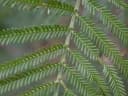
Acacia mearnsii
Acacia mearnsii
Safety & Hazards
Especially in times of drought, many Acacia species can concentrate high levels of the toxin Hydrogen cyanide in their foliage, making them dangerous for herbivores to eat.
Cultivation Details
Acacia mearnsii is a plant of warm temperate to subtropical areas, it can also be grown at moderate to high elevations in the tropics. It is found at elevations from 300 - 2,440 metres in areas where the mean annual temperature is in the range 9 - 20°c and the mean annual rainfall is 500 - 2,050 mm[1]. It prefers a moderate climate, exhibiting great intolerance to extreme heat or cold[1]. Its lower altitudinal range is decided by the fact that trees cannot stand high summer temperatures, and the upper altitudinal limit is based on the fact that the tree does not tolerate temperatures below 0°c[1]. Winter frosts and cold winds during the early part of the rainy season affect growth and survival rate, but older trees can withstand mild frost[1]. Localities experiencing severe hailstorms and snowfall are generally unsuitable[1]. Requires a sunny position[2]. Flourishes in deep, well drained, light textured and moist soils[1]. It thrives in well-aerated, neutral to acid soils, loamy soils, soils derived from shale or slate and is highly intolerant of alkaline and calcareous soils[1]. Soils with lateritic pan close to the surface are most unsuitable[1]. Adequate soil moisture is a prerequisite for satisfactory growth[1]. Trees cannot withstand drought because of their superficial root system and high rate of transpiration[1]. Trees are fast-growing, but short-lived, with a life span generally in the range 10 - 30 years[2]. They begin to yield fertile seed from the age of 5 years, giving good annual crops[1]. The tree regenerates naturally from seed after burning in clear-felled plantations[1]. Seed may lie dormant in the soil for up to 6 years without loss of viability[1]. A large proportion of the seed may become dormant in the soil and may remain viable for more than 50 years[2]. The trees have strong light requirements and respond to thinning in the early years. Growth rate is comparatively slow for the first 1 or 2 years. Thereafter, both height and diameter increments are rapid up to the age of 6 - 7 years, after which they fall off gradually[1]. The tree has low coppicing power[1]. Taproot development largely depends upon the depth of the soil, but the tree has the general tendency to develop a superficial lateral root system. Because of this, trees are liable to being uprooted by strong gales during the monsoon season[1]. This species has a symbiotic relationship with certain soil bacteria, these bacteria form nodules on the roots and fix atmospheric nitrogen. Some of this nitrogen is utilized by the growing plant but some can also be used by other plants growing nearby[3].
Propagation
Seed - best sown as soon as it is ripe in a sunny position in a warm greenhouse[4].The dried seed of most, if not all, members of this genus has a hard seedcoat and may benefit from scarification before sowing to speed up germination. This can usually be done by pouring a small amount of nearly boiling water on the seeds (being careful not to cook them!) and then soaking them for 12 - 24 hours in warm water. By this time they should have imbibed moisture and swollen - if they have not, then carefully make a nick in the seedcoat (being careful not to damage the embryo) and soak for a further 12 hours before sowing. Sow the seed in Spring in a greenhouse. As soon as the seedlings are large enough to handle, prick them out into individual pots and grow them on in a sunny position in the greenhouse for their first winter. Plant them out in late spring or early summer, after the last expected frosts, and consider giving them some protection from the cold for their first winter outdoors. Acacia seeds that have matured fully on the bush and have been properly dried have a hard seed coat and can be stored in closed containers without deterioration for 5 - 10 years or more in dry conditions at ambient temperatures. It is best to remove the aril, which attracts weevils and can lead to moulds forming. The arils are easilyremoved by placing the seeds in water and rubbing them between the hands, then drying the seeds and winnowing them[5]. Cuttings of half-ripe wood with a heel, mid summer in individual pots in a frame[6]. Overwinter in a greenhouse for the first winter and plant out in their permanent positions in late spring or early summer. Fair percentage[6]. Cite as: Temperate Plants Database, Ken Fern. temperate.theferns.info. 2026-02-20. <temperate.theferns.info/plant/Acacia+mearnsii>
Pollinators
Bees, Insects, Self
References
- [1]World Agroforesty Centre — http://www.worldagroforestry.org/ ↩︎An excellent online database of a huge range of trees giving very good information on each plant - its uses, ecology, identity, propagation, pests etc.
- [2]Invasive Species Compendium — http://www.cabi.org ↩︎An immense resource - in depth information on over 900 species of invasive plants (it also has information on animals, fungi etc).
- [3]The New RHS Dictionary of Gardening. 1992. — Huxley. A. · MacMillan Press · 1992 · ISBN 0-333-47494-5 ↩︎Excellent and very comprehensive, though it contains a number of silly mistakes. Readable yet also very detailed.
- [4]RHS Dictionary of Plants plus Supplement. 1956 — F. Chittendon. · Oxford University Press · 1951 · ISBN - ↩︎Comprehensive listing of species and how to grow them. Somewhat outdated, it has been replaced in 1992 by a new dictionary (see [ 200 ]).
- [5]Potential of Australian Acacias in combating hunger in semi-arid lands — Rinaudo A.; Patel P.; Thomson L.A.J. · 2002 ↩︎
- [6]Propagation of Trees, Shrubs and Conifers. — Sheat. W. G. · MacMillan and Co · 1948 · ISBN - ↩︎A bit dated but a good book on propagation techniques with specific details for a wide range of plants.
- [7]Plant Resources of Southeast Asia — http://proseanet.org/ ↩︎Lots of information on the uses of the plants of SE Asia.
- [8]Global Invasive Species Database — http://www.issg.org/database/welcome/ ↩︎Very detailed information on almost 400 species (with more being added) of plants that have become weeds in areas outside their native range.
- [9]The Useful Native Plants of Australia. — Maiden J.H. · Turner & Co.; London. · 1889 · http://www.biodiversitylibrary.org ↩︎Terse details of the uses of many Australian plants and other species naturalised, or at least growing, in Australia. It can be downloaded from the Internet.
- [10]Protabase - Plant Resources of Tropical Africa. — http://www.prota.org ↩︎An excellent on-line database with detailed information on over 3,200 species of useful plants of Africa.
- [11]Tropical Timbers of the World. Ag. Handbook No. 607. — Chudnoff. Martin. · USDA Forest Service. Wisconsin. · 1984 ↩︎Terse details on the properties of the wood of almost 400 species of trees from the Tropics.