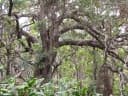
Acacia koa
Acacia koa
Safety & Hazards
Especially in times of drought, many Acacia species can concentrate high levels of the toxin Hydrogen cyanide in their foliage, making them dangerous for herbivores to eat.
Cultivation Details
Trees grow naturally in the tropics, usually at an elevation between 180 - 6,000 metres[1]. They grow in areas where the mean annual rainfall is in the range 1,900 - 5,100mm[1]. It grows well in moderately to well-drained, medium to very strongly acid soils on both flatland and steep slopes[1, 2] Trees occurring in dense, wet native forest stands typically retain a straight, narrow form[1]. In the open, trees develop more spreading, branching crowns and shorter, broader trunks[1]. The tree has one main tap root and an otherwise shallow, spreading root system[1]. Observations suggest Acacia koa can flower almost any time of year, depending upon local weather conditions. Trees appear to be self-fertilizing[1]. Pods reach maturity at 4-6 months, depending on location and weather conditions[1]. Seed production begins when trees are 5 years old[1]. A. koa bears seed often and abundantly[1]. A fast-growing tree[2]. On favourable sites, planted seedlings grow to 9 metres in 5 years[1]. This species has a symbiotic relationship with certain soil bacteria, these bacteria form nodules on the roots and fix atmospheric nitrogen. Some of this nitrogen is utilized by the growing plant but some can also be used by other plants growing nearby[3]. A. koa is nodulated by the slow-growing Bradyrhizobium spp. Common in tropical soils. It nodulates heavily in a variety of soils, suggesting it is effective with a wide variety of Bradyrhizobia strains[1].
Propagation
The seed of most, if not all, members of this genus has a hard seedcoat and may benefit from scarification before sowing to speed up germination. This can usually be done by pouring a small amount of nearly boiling water on the seeds (being careful not to cook them!) and then soaking them for 12 - 24 hours in warm water. By this time they should have imbibed moisture and swollen - if they have not, then carefully make a nick in the seedcoat (being careful not to damage the embryo) and soak for a further 12 hours before sowing. Once treated, seeds are sown in nursery beds. 1 week after germination, seedlings are transplanted into nursery tubes or bags. Seedlings are ready for transplanting into the field when they are approximately 20cm tall, (after 3-4 months in the nursery). Establishment by direct seeding or encouragement of natural regeneration is recommended as heart rot occurs during transplanting. One study recommends air-layering as the best vegetative propagation technique. The seeds are durable and easy to store. They germinate after many years of storage if kept in a cool, dry place. The most effective method for improving seed germination is mechanical scarification. However, hot water soaking works well and is a more practical method, seed should be soaked in boiled water for 24 hours. Seeds are seldom dispersed far from the tree and remain viable in the soil for up to 25 years. Cite as: Tropical Plants Database, Ken Fern. tropical.theferns.info. 2026-02-19. <tropical.theferns.info/viewtropical.php?id=Acacia+koa>
Pollinators
Bees
References
- [1]World Agroforesty Centre — http://www.worldagroforestry.org/ ↩︎An excellent online database of a huge range of trees giving very good information on each plant - its uses, ecology, identity, propagation, pests etc.
- [2]IUCN Red List of Threatened Species — http://www.iucnredlist.org/ ↩︎A list of plants under threat and facing possible extinction, usually with brief details of the threats and information on habitat.
- [3]The New RHS Dictionary of Gardening. 1992. — Huxley. A. · MacMillan Press · 1992 · ISBN 0-333-47494-5 ↩︎Excellent and very comprehensive, though it contains a number of silly mistakes. Readable yet also very detailed.
- [4]The Useful Native Plants of Australia. — Maiden J.H. · Turner & Co.; London. · 1889 · http://www.biodiversitylibrary.org ↩︎Terse details of the uses of many Australian plants and other species naturalised, or at least growing, in Australia. It can be downloaded from the Internet.
- [5]Dictionary of Economic Plants. — Uphof. J. C. Th. · Weinheim · 1959 · ISBN - ↩︎An excellent and very comprehensive guide but it only gives very short descriptions of the uses without any details of how to utilize the plants. Not for the casual reader.
- [PFAF]Plants for a Future — pfaf.org ↩︎