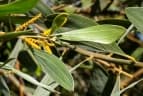
Acacia holosericea
Acacia holosericea
Safety & Hazards
The plant (probably the seeds[PFAF]) has been used as a fish poison[1]. The seed of many Acacia species is edible and highly nutritious, and can be eaten safely as a fairly major part of the diet[2]. Not all species are edible however, and some, including this species, can contain moderate levels of toxins[2]. Especially when harvesting from the wild, especial care should be taken to ensure correct identification of any plants harvested for food[PFAF]. Especially in times of drought, many Acacia species can concentrate high levels of the toxin Hydrogen cyanide in their foliage, making them dangerous for herbivores to eat.
Cultivation Details
Acacia holosericea is a plant of the drier, seasonal tropics of northern Australia, where it is found at elevations up to 750 metres. It grows best in areas where annual daytime temperatures are within the range 24 - 32°c, but can tolerate 12 - 45°c[3]. When dormant, the plant can survive temperatures down to about -1°c[3]. It prefers a mean annual rainfall in the range 600 - 1,200mm, but tolerates 250 - 1,600mm[3]. Requires a sunny position[3]. Dislikes heavier soils[3]. Succeeds in soils of low fertility[3]. Prefers a well-drained soil, but tolerant of dry conditions and seasonal inundation of the soil[3]. Prefers a pH in the range 5.5 - 7.5, tolerating 4.5 - 8.5[3]. The early and abundant seeding of this plant has the potential of making it a weed. Seed dispersal is prompted by propulsion from drying dehiscent pods. Browsing vertebrates sometimes also play a role in seed dispersal[4]. Early rapid growth makes this tree a highly productive fuelwood source. Trees 4 years old can yield up to 13 tonnes per hectare[5]. The seeds of most acacia species can be quickly and efficiently harvested at full maturity without the need for any specialised equipment. Small seed-bearing branches can be cut and beaten on sheets, or bushes can be beaten or shaken directly onto large sheets[6]. The tree can be lopped or pollarded, but generally does not respond well to coppicing[5]. This species has a symbiotic relationship with certain soil bacteria; these bacteria form nodules on the roots and fix atmospheric nitrogen. Some of this nitrogen is utilized by the growing plant but some can also be used by other plants growing nearby[7].
Propagation
Seed - it has a hard seedcoat and benefits from scarification before sowing in order to speed up and improve germination. This can usually be done by pouring a small amount of nearly boiling water on the seeds (being careful not to cook them!) and then soaking them for 12 - 24 hours in warm water. By this time they should have imbibed moisture and swollen - if they have not, then carefully make a nick in the seedcoat (being careful not to damage the embryo) and soak for a further 12 hours before sowing. Seeds can store for 14 years at room temperature with only 11% loss of viability[5]. Cite as: Tropical Plants Database, Ken Fern. tropical.theferns.info. 2026-02-19. <tropical.theferns.info/viewtropical.php?id=Acacia+holosericea>
Pollinators
Insects, Birds
References
- [1]Australian Tropical Rainforest Plants — http://www.anbg.gov.au/cpbr/cd-keys/rfk/index.html ↩︎An online resource giving botanical information, and a little bit about plant usage, for over 2,700 species of plants found in the Australian rainforest.
- [2]Acacia in Australia: Ethnobotany and Potential Food Crop — Lister P.R.; Holford P.; Haigh T.; Morrison D.A. · ASHS Press, Alexandria, VA. · 1996 · https://hort.purdue.edu/newcrop/proceedings1996/v3-toc.html · ISBN 0-9615027-3-8 ↩︎
- [3]Ecocrop — http://ecocrop.fao.org/ecocrop/srv/en/home ↩︎Basic information on a wide range of useful plants, plus details of environmental needs where available.
- [4]Pacific Island Ecosystems at Risk — http://www.hear.org/pier/scientificnames/index.html ↩︎A very good website detailing weed species that have been introduced into the Pacific Islands.
- [5]World Agroforesty Centre — http://www.worldagroforestry.org/ ↩︎An excellent online database of a huge range of trees giving very good information on each plant - its uses, ecology, identity, propagation, pests etc.
- [6]Potential of Australian Acacias in combating hunger in semi-arid lands — Rinaudo A.; Patel P.; Thomson L.A.J. · 2002 ↩︎
- [7]Nodulation Plants in GRIN Taxonomy — United States Department of Agriculture · http://www.ars-grin.gov/~sbmljw/cgi-bin/taxnodul.pl?language=en ↩︎An online database listing plants that have either positive or negative reports on root and stem nodulation with nitrogen-fixing bacteria.
- [8]Flora of Australia — http://www.anbg.gov.au/abrs/abif/flora/ ↩︎The full information from the Flora of Australia - on-line. An excellent resource.
- [9]Australian Native Plants Society — http://anpsa.org.au/index.html ↩︎A series of fact sheets on Australian plants. Good photographs, brief description and information on uses, habitat, range, cultivation etc.
- [10]Australian Trees and Shrubs: Species for Land Rehabilitation and Farm Planting in the Tropics — Doran J.C.; Turnbull J.W. (Editors) · Australian Centre for International Agricultural Research; Canbe · 1997 · ISBN 1-86320-127-0 ↩︎A very informative book, rich in information about the uses, cultivation needs and very much more for over 160 species of Australian trees and shrubs.
- [11]The Useful Native Plants of Australia. — Maiden J.H. · Turner & Co.; London. · 1889 · http://www.biodiversitylibrary.org ↩︎Terse details of the uses of many Australian plants and other species naturalised, or at least growing, in Australia. It can be downloaded from the Internet.
- [PFAF]Plants for a Future — pfaf.org ↩︎