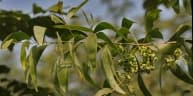
Acacia auriculiformis
Acacia auriculiformis
Safety & Hazards
Especially in times of drought, many Acacia species can concentrate high levels of the toxin Hydrogen cyanide in their foliage, making them dangerous for herbivores to eat.
Cultivation Details
The tree is predominantly found at low elevations in the seasonally dry tropical lowlands of the humid and sub-humid zones[1]. It is usually found at elevations below 80 metres, but can be found up to 400 metres[1]. In its natural range, the mean annual rainfall varies from 700 - 2,000 mm, and the dry season (i.e. Monthly rainfall less than 40 mm) can be up to 7 months[1]. The mean maximum temperature of the hottest month is 32 - 34°c, and the mean minimum of the coolest month is 17 - 22°c[1]. Frost does not occur in its natural range, but elsewhere, it tolerates light frost[1]. Requires a sunny position, it is very intolerant of shade[1, 2]. Found most commonly on clay soils, it exhibits the ability to grow in a wide variety of soils including calcareous sands and black cracking clays, poor-fertility soils, seasonally waterlogged soils, sandy loams and coral rag[1, 3]. It can also tolerate highly alkaline and saline soils, pH ranging between 4.3 and 9[1, 2]. It has brittle, easily-broken branches and therefore requires a position sheltered from strong winds[1]. Established plants can tolerate periodic inundation and are also very drought tolerant[4]. Often cultivated for timber outside its native range, the tree has escaped from cultivation in many parts of the tropics and has become an invasive weed in some areas[1, 5]. Very fast-growing, an increment in height of 2 - 4 metres per year in the first few years is common even on soils of low fertility[1]. The optimal planting density is not clearly established. Most current plantings are spaced at 2 - 4 x 2 - 4 metres, the closer spacing being more suitable for firewood and pulp plantations[1]. The tree responds well to pollarding[1]. Young trees respond to coppicing better than old trees, but the tree does not sprout vigorously or prolifically. Best results are obtained if the stump is cut at a height of 0.6 - 1 metre above the ground[1]. Under favourable conditions, trees may reach a height of 15 metres in 5 years and produce an annual wood increment of 15-20 cubic m/ha over 10 - 12 years[1]. Recommended rotation is 4 - 5 years for fuel wood, 8 - 10 years for pulp and 12 - 15 years for timber[1]. Removal of lower branches and of young plants has been suggested as a means of improving stem form and of reducing the incidence of multiple stems[1]. The tree has a shallow, spreading root system[1]. Seedlings have the ability to compete with Imperata cylindrica during early growth phases and once mature may reduce the grass to a sparse ground cover[1]. Hybridizes with A. Mangium[6]. The plant flowers and produces fruit throughout much of the year[7]. This species has a symbiotic relationship with certain soil bacteria, these bacteria form nodules on the roots and fix atmospheric nitrogen. Some of this nitrogen is utilized by the growing plant but some can also be used by other plants growing nearby[8].
Propagation
Seed - requires pre-treatment to break down the hard coat[1]. Pouring a small amount of boiling water over the seeds (which cools down quickly and so does not cook the seed), and then leaving to soak for 12 hours is usually effective, as is making a small incision in the coat to allow water to penetrate. Germination levels of 40 - 80% take place in 6 - 15 days[1]. Treated seeds are sown in germination beds, and seedlings are transplanted into polythene bags when they reach the 2-leaf-pair stage. Seeds can also be sown straight into polythene bags. Young seedlings should initially be kept at 50% sunlight, but this can be increased to 70% once they have been established. In general, 3 - 4 months are needed to raise seedlings to a plantable size, 25 cm in height[1]. Seeds stored in airtight containers at room temperature retain their viability for several years[1]. Cuttings. Air layering. Cite as: Tropical Plants Database, Ken Fern. tropical.theferns.info. 2026-02-19. <tropical.theferns.info/viewtropical.php?id=Acacia+auriculiformis>
Pollinators
Insects
References
- [1]World Agroforesty Centre — http://www.worldagroforestry.org/ ↩︎An excellent online database of a huge range of trees giving very good information on each plant - its uses, ecology, identity, propagation, pests etc.
- [2]Digital Compendium of Forestry Species of Cambodia — www.digitalspecies.blogspot.com; Phnom Penh · 2008 · http://www.digitalspecies.blogspot.com ↩︎A very detailed booklet, produced in PDF format on the internet, giving information on around 100 species of trees.
- [3]IUCN Red List of Threatened Species — http://www.iucnredlist.org/ ↩︎A list of plants under threat and facing possible extinction, usually with brief details of the threats and information on habitat.
- [4]Institute of Food and Agricultural Sciences, University of Florida — University of Florida · http://hort.ifas.ufl.edu/shrubs/ ↩︎PDF fact sheets on over 500 shrubs.
- [5]Pacific Island Ecosystems at Risk — http://www.hear.org/pier/scientificnames/index.html ↩︎A very good website detailing weed species that have been introduced into the Pacific Islands.
- [6]Trees Commonly Cultivated in SE Asia — Jensen. M. · FAO Regional Office, Bangkok. · 1999 · ISBN 974-89377-5-5 ↩︎
- [7]Flora Malesiana Series 1 — Various · Nationaal Herbarium Nederiand, Universiteit Leiden branch · http://www.archive.org ↩︎A massive treatment of the plants of the Malaysian Archipelago. Much of it has been made available to download from the Internet
- [8]Australian Trees and Shrubs: Species for Land Rehabilitation and Farm Planting in the Tropics — Doran J.C.; Turnbull J.W. (Editors) · Australian Centre for International Agricultural Research; Canbe · 1997 · ISBN 1-86320-127-0 ↩︎A very informative book, rich in information about the uses, cultivation needs and very much more for over 160 species of Australian trees and shrubs.
- [9]Australian Native Plants Society — http://anpsa.org.au/index.html ↩︎A series of fact sheets on Australian plants. Good photographs, brief description and information on uses, habitat, range, cultivation etc.
- [10]Plant Resources of Southeast Asia — http://proseanet.org/ ↩︎Lots of information on the uses of the plants of SE Asia.
- [11]Trees of Sungai Wain — http://www.nationaalherbarium.nl/Sungaiwain/ ↩︎An excellent site with factsheets on almost 1,000 species of forest trees growing at Sungai Wain in Indonesia. Each factsheet has good quality pictures plus basic information on the ecology and uses of the plants.
- [12]The Useful Native Plants of Australia. — Maiden J.H. · Turner & Co.; London. · 1889 · http://www.biodiversitylibrary.org ↩︎Terse details of the uses of many Australian plants and other species naturalised, or at least growing, in Australia. It can be downloaded from the Internet.
- [PFAF]Plants for a Future — pfaf.org ↩︎