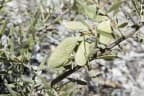
Acacia aneura
Acacia aneura
Safety & Hazards
The seed of many Acacia species, including this one, is edible and highly nutritious, and can be eaten safely as a fairly major part of the diet. Not all species are edible, however, and some can contain moderate levels of toxins[1]. Especially when harvesting from the wild, especial care should be taken to ensure correct identification of any plants harvested for food[PFAF]. Especially in times of drought, many Acacia species can concentrate high levels of the toxin Hydrogen cyanide in their foliage, making them dangerous for herbivores to eat.
Cultivation Details
A plant of arid and semi-arid areas of the tropics and subtropics, growing naturally at elevations from sea level to about 1000 metres[2]. It is found in areas with an annual rainfall in the range of 100 - 500 mm[2]. It its native range it experiences hot summers and cool winters with light frost[2]. It has been known to experience occasional temperatures as low as -7°c in its native range[3]. Prefers a sandy loam and a very sunny position[4]. Succeeds in any good garden soil that is not excessively limey[5]. Most species of Acacia become chlorotic on limey soils[6]. In the wild this species tolerates periodic inundation[7]. Young plants quickly produce a long taproot with an extensive lateral root system in the top 30cm of the soil and, once this is established, they become very drought tolerant[8, 2]. Growth rate is generally slow, but is related to moisture conditions. In central Australia planted specimens receiving an average of 370mm of rainfall a year grew in ten years into multi-stemmed shrubs 3 metres tall with a bole 2 - 4cm in diameter and with a crown diameter of 2 metres[9]. Cultivated specimens receiving regular irrigation have reached 10 metres tall with a bole diameter of 10cm within 10 years[9]. In trials where rainfall is relatively high, the Charleville, Queensland provenance, a broad phyllode form, has grown more rapidly than provenances from central Australia[9]. Plants are very sensitive to fire, and can also be killed by severe lopping[10, 11]. Trees can flower several times over the year, usually with two distinctive periods of heaviest flowering[2]. It is an excellent pollen producing species that is important to beekeepers[2]. This species has a symbiotic relationship with certain soil bacteria, these bacteria form nodules on the roots and fix atmospheric nitrogen. Some of this nitrogen is utilized by the growing plant but some can also be used by other plants growing nearby[6].
Propagation
Seed - best sown as soon as it is ripe in a sunny position in a warm greenhouse[4]. Stored seed should be scarified, pre-soaked for 12 hours in warm water and then sown in a warm greenhouse in early spring. The seed germinates in 3 - 4 weeks at 25°c[12]. As soon as the seedlings are large enough to handle, prick them out into individual pots and grow them on in a sunny position in the greenhouse for their first winter. Plant them out in late spring or early summer, after the last expected frosts, and consider giving them some protection from the cold for their first winter outdoors. Cuttings of half-ripe wood with a heel, mid summer in individual pots in a frame[13]. Overwinter in a greenhouse for the first winter and plant out in their permanent positions in late spring or early summer. Fair percentage[13]. Cite as: Temperate Plants Database, Ken Fern. temperate.theferns.info. 2026-02-20. <temperate.theferns.info/plant/Acacia+aneura>
Pollinators
Bees, Insects
References
- [1]Acacia in Australia: Ethnobotany and Potential Food Crop — Lister P.R.; Holford P.; Haigh T.; Morrison D.A. · ASHS Press, Alexandria, VA. · 1996 · https://hort.purdue.edu/newcrop/proceedings1996/v3-toc.html · ISBN 0-9615027-3-8 ↩︎
- [2]Seed Leaflets — Various · Forest & Landscape. Denmark · http://en.sl.life.ku.dk/Publikationer/Udgivelser/PopulaerPublikationer.aspx?katid={D28373CC-6EF3-4EF8-B097-6D83FABF209E}&serieid={9F1C3DB1-6E7B-4CF1-AF53-F480B0CB40EF}&sort=title ↩︎A series of leaflets, jointly produced by the University of Copenhagen and the Royal Botanic Gardens at Kew, focussing on seed information for a number species, but also giving a lot of other information about each plant.
- [3]Australian Native Plants. — Wrigley. J. W. and Fagg. M. · Collins. (Australia) · 1988 · ISBN 0-7322-0021-0 ↩︎A lovely book, written in order to encourage Australian gardeners to grow their native plants. A little bit of information for the plant project.
- [4]RHS Dictionary of Plants plus Supplement. 1956 — F. Chittendon. · Oxford University Press · 1951 · ISBN - ↩︎Comprehensive listing of species and how to grow them. Somewhat outdated, it has been replaced in 1992 by a new dictionary (see [ 200 ]).
- [5]Trees and Shrubs Hardy in Great Britain. Vol 1 - 4 and Supplement. — Bean. W. · Murray · 1981 · ISBN - ↩︎A classic with a wealth of information on the plants, but poor on pictures.
- [6]The New RHS Dictionary of Gardening. 1992. — Huxley. A. · MacMillan Press · 1992 · ISBN 0-333-47494-5 ↩︎Excellent and very comprehensive, though it contains a number of silly mistakes. Readable yet also very detailed.
- [7]A Field Guide to Australian Trees. — Holliday. I. and Hill. R. · Frederick Muller Ltd. · 1974 · ISBN 0-85179-627-3 ↩︎A well illustrated and very readable book, but it does not contain much information for the plant project.
- [8]Scented Flora of the World. — Genders. R. · Robert Hale. London. · 1994 · ISBN 0-7090-5440-8 ↩︎An excellent, comprehensive book on scented plants giving a few other plant uses and brief cultivation details. There are no illustrations.
- [9]World Agroforesty Centre — http://www.worldagroforestry.org/ ↩︎An excellent online database of a huge range of trees giving very good information on each plant - its uses, ecology, identity, propagation, pests etc.
- [10]Traditional Trees of Pacific Islands — Elevitch. Craig. R. (Editor) · Permanent Agriculture Resources, Hawaii · 2006 · ISBN 0970254458 ↩︎Beautifully produced book with superb photos and detailed information on over 50 species of useful plants of the Pacific Islands.
- [11]IUCN Red List of Threatened Species — http://www.iucnredlist.org/ ↩︎A list of plants under threat and facing possible extinction, usually with brief details of the threats and information on habitat.
- [12]Growing from Seed. Volume 1. — Rice. G. (Editor) · Thompson and Morgan. · 1987 · ISBN - ↩︎Very readable magazine with lots of information on propagation.
- [13]Propagation of Trees, Shrubs and Conifers. — Sheat. W. G. · MacMillan and Co · 1948 · ISBN - ↩︎A bit dated but a good book on propagation techniques with specific details for a wide range of plants.
- [14]Australian Native Plants Society — http://anpsa.org.au/index.html ↩︎A series of fact sheets on Australian plants. Good photographs, brief description and information on uses, habitat, range, cultivation etc.
- [15]Domestication of wattles with edible seeds for the wheatbelt of Western Australia — McDonald M.W.; Maslin B.R.; Thomson L.A.J. · 2002 ↩︎
- [16]Wild Food in Australia. — Cribb. A. B. and J. W. · Fontana · 1976 · ISBN 0-00-634436-4 ↩︎A very good pocket guide.
- [17]Cornucopia - A Source Book of Edible Plants. — Facciola. S. · Kampong Publications · 1990 · ISBN 0-9628087-0-9 ↩︎Excellent. Contains a very wide range of conventional and unconventional food plants (including tropical) and where they can be obtained (mainly N. American nurseries but also research institutes and a lot of other nurseries from around the world.
- [18]Wild Food Plants of Australia. — Low. T. · Angus and Robertson. · 1989 · ISBN 0-207-14383-8 ↩︎Well presented, clear information and good photographs. An interesting read for the casual reader as well as the enthusiast
- [19]Dictionary of Economic Plants. — Uphof. J. C. Th. · Weinheim · 1959 · ISBN - ↩︎An excellent and very comprehensive guide but it only gives very short descriptions of the uses without any details of how to utilize the plants. Not for the casual reader.
- [20]Plants for Human Consumption. — Kunkel. G. · Koeltz Scientific Books · 1984 · ISBN 3874292169 ↩︎An excellent book for the dedicated. A comprehensive listing of Latin names with a brief list of edible parts.
- [21]Flora of Australia — http://www.anbg.gov.au/abrs/abif/flora/ ↩︎The full information from the Flora of Australia - on-line. An excellent resource.
- [22]Wattleseed — Lister. P. · http://www.uws.edu.au/vip/listerp/wattle.htm ↩︎A very interesting article on the internet about the Aboriginal uses of the Genus Acacia in Australia.
- [23]The Useful Native Plants of Australia. — Maiden J.H. · Turner & Co.; London. · 1889 · http://www.biodiversitylibrary.org ↩︎Terse details of the uses of many Australian plants and other species naturalised, or at least growing, in Australia. It can be downloaded from the Internet.
- [24]Nature's Colors - Dyes from Plants. — Grae. I. · MacMillan Publishing Co. New York. · 1974 · ISBN 0-02-544950-8 ↩︎A very good and readable book on dyeing.
- [25]Useful Wild Plants in Australia. — Cribb. A. B. and J. W. · William Collins Pty Ltd. Sidney · 1981 · ISBN 0-00-216441-8 ↩︎A very readable book.
- [26]A Manual of the Timbers of the World — Howard A.L. · MacMillan and Co.; London. · 1934 · http://www.biodiversitylibrary.org ↩︎An excellent and comprehensive book on timbers. Rather dated, but still a main source of information for many of the less known woods. It can be downloaded from the Internet.
- [PFAF]Plants for a Future — pfaf.org ↩︎