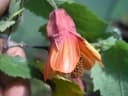
Abutilon megapotamicum
Abutilon megapotamicum
Safety & Hazards
None known
Cultivation Details
Abutilon megapotamicum is a plant of the warm temperate to subtropical zone of southern Brazil. It only succeeds outdoors in the warmer parts of the temperate zone, though it can tolerate temperatures down to between -5 to -10°c when given the protection of a sunny, sheltered wall[1, 2, 3]. A deep mulch in winter and tying in growth to the wall will maximise protection in winter[3]. If the plant is cut back by cold weather, it will often resprout from the base in the spring and can flower on the current year's growth[4]. Requires a sunny position or part day shade in a fertile well-drained soil[3]. Dislikes drought[3]. Dead-heading plants to prevent seeding can enhance longevity[3]. Tip-prune young plants to promote a bushy habit, older plants can be cut back hard annually in spring if required[3]. There are some named forms, selected for their ornamental value[3]. There is a variegated form in cultivation, this variegation is as a result of infection by abutilon mosaic virus[2, 3]. Plants in this genus are notably resistant to honey fungus[3].
Propagation
Seed - sow spring in a greenhouse[3]. Germination should take place within a few weeks. Once the seedlings are large enough to handle, prick them out into individual pots. Grow them on for at least the first winter in a greenhouse and plant out in late spring or early summer, after the last expected frosts. Cuttings of young shoots, early summer in a frame[3]. Grow on in the greenhouse for their first winter and plant out in spring after the last expected frosts. Cuttings of half-ripe wood, mid summer in a frame[3]. Grow on in the greenhouse for their first winter and plant out in spring after the last expected frosts. Cite as: Temperate Plants Database, Ken Fern. temperate.theferns.info. 2026-02-20. <temperate.theferns.info/plant/Abutilon+megapotamicum>
Pollinators
Insects
References
- [1]Trees and Shrubs Hardy in Great Britain. Vol 1 - 4 and Supplement. — Bean. W. · Murray · 1981 · ISBN - ↩︎A classic with a wealth of information on the plants, but poor on pictures.
- [2]Shrubs. — Phillips. R. & Rix. M. · Pan Books · 1989 · ISBN 0-330-30258-2 ↩︎Excellent photographs and a terse description of 1,900 species and cultivars.
- [3]The New RHS Dictionary of Gardening. 1992. — Huxley. A. · MacMillan Press · 1992 · ISBN 0-333-47494-5 ↩︎Excellent and very comprehensive, though it contains a number of silly mistakes. Readable yet also very detailed.
- [4]Climbers and Wall Shrubs. — Davis. B. · Viking. · 1990 · ISBN 0-670-82929-3 ↩︎Contains information on 2,000 species and cultivars, giving details of cultivation requirements. The text is terse but informative.
- [5]Cornucopia - A Source Book of Edible Plants. — Facciola. S. · Kampong Publications · 1990 · ISBN 0-9628087-0-9 ↩︎Excellent. Contains a very wide range of conventional and unconventional food plants (including tropical) and where they can be obtained (mainly N. American nurseries but also research institutes and a lot of other nurseries from around the world.
- [PFAF]Plants for a Future — pfaf.org ↩︎