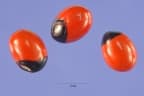
Abrus precatorius
Abrus precatorius
Safety & Hazards
All parts of the plant, but especially the seeds, contain the extremely toxic substance abrin[1, 2]. The seeds are extremely toxic, eating even one is sufficient to cause stomach cramps, vomiting, birth deformities, sterility, coma or death[1]. The seeds can even cause death if they are brought into contact with an open wound[3, 2]. The toxins can be destroyed by heating the seeds[4]. Other parts of the plant, especially the root, are sometimes used as a liquorice substitute even though they contain minute amounts of the toxins[1, 2].
Cultivation Details
Prefers a rich, well-drained, sandy loam and a position in full sun or partial shade[1]. Plants are tolerant of saline conditions[1]. The plant has escaped from cultivation in many areas in many areas outside its native range, and become established in the wild. It establishes well in disturbed sites and spreads rapidly after fires, becoming a weed of pastures and non-cropland[5]. Like many other species in the Fabaceae, this species is very sensitive to changes in the intensity of light, the leaflets hanging down vertically at night, as though asleep, and rising with the dawn. These movements are also caused in a measure by the overclouding and clearing of the sky[4]. This species has a symbiotic relationship with certain soil bacteria, these bacteria form nodules on the roots and fix atmospheric nitrogen. Some of this nitrogen is utilized by the growing plant but some can also be used by other plants growing nearby[6].
Propagation
Seed - pre-soak for 24 hours in warm water prior to sowing[1]. Softwood cuttings. Cite as: Tropical Plants Database, Ken Fern. tropical.theferns.info. 2026-02-19. <tropical.theferns.info/viewtropical.php?id=Abrus+precatorius>
Pollinators
Data unavailable
References
- [1]Encyclopaedia of Herbs and their Uses. — Bown. D. · Dorling Kindersley, London. · 1995 · ISBN 0-7513-020-31 ↩︎A very well presented and informative book on herbs from around the globe. Plenty in it for both the casual reader and the serious student. Just one main quibble is the silly way of having two separate entries for each plant.
- [2]The Encyclopedia of Medicinal Plants — Chevallier. A. · Dorling Kindersley. London · 1996 · ISBN 9-780751-303148 ↩︎An excellent guide to over 500 of the more well known medicinal herbs from around the world.
- [3]Dictionary of Economic Plants. — Uphof. J. C. Th. · Weinheim · 1959 · ISBN - ↩︎An excellent and very comprehensive guide but it only gives very short descriptions of the uses without any details of how to utilize the plants. Not for the casual reader.
- [4]The Useful Plants of the Island of Guam — Safford W.E. · Smithsonian Institute; Washington. · 1905 · http://www.biodiversitylibrary.org/ ↩︎A very comprehensive, if rather dated, guide to the plants of Guam. It can be downloaded from the Internet.
- [5]Pacific Island Ecosystems at Risk — http://www.hear.org/pier/scientificnames/index.html ↩︎A very good website detailing weed species that have been introduced into the Pacific Islands.
- [6]The New RHS Dictionary of Gardening. 1992. — Huxley. A. · MacMillan Press · 1992 · ISBN 0-333-47494-5 ↩︎Excellent and very comprehensive, though it contains a number of silly mistakes. Readable yet also very detailed.
- [7]Flora of China — Missouri Botanical Garden Press; St. Louis. · 1994 · http://flora.huh.harvard.edu/china/ ↩︎An excellent, comprehensive resource in 25 volumes. In addition to the botanical information the flora also gives basic information on habitat and some uses. An on-line version is also available.
- [8]Plant Resources of Southeast Asia — http://proseanet.org/ ↩︎Lots of information on the uses of the plants of SE Asia.
- [9]A Handbook to the Flora of Ceylon — Trimen H.; continued by Hooker J.D. · Dulau and Co; London. · 1898 · http://www.biodiversitylibrary.org ↩︎Very dated, but still a useful work. It can be downloaded from the Internet.
- [10]Plants and People of Nepal — Manandhar. N. P. · Timber Press. Oregon. · 2002 · ISBN 0-88192-527-6 ↩︎Excellent book, covering over 1,500 species of useful plants from Nepal together with information on the geography and peoples of Nepal. Good descriptions of the plants with terse notes on their uses.
- [11]The Leguminosae; A Source Book of Characteristics, Uses and Nodulation — Allen O.N.; Allen E.K. · University of Wisconsin · 1981 · ISBN 0-333-32221-5 ↩︎An amazing and comprehensive work, giving a brief guide to the many genera of the family Fabaceae and also the principle uses of the genus.
- [12]Medicinal Plants in Vietnam — Nguyen Van Dan & Doan Thi Nhu · World Health Organisation · 1989 · ISBN 92 9061 101 4 ↩︎An excellent book, giving information on over 200 plants, their medicinal compounds and applications.
- [13]Medicinal Plants of the Guianas — DeFilipps, R. A.; Maina, S. L.; & Crepin, J. · Smithsonian Museum · http://botany.si.edu/bdg/medicinal/index.html ↩︎A down-loadable PDF document of a book in pre-publication awaiting illustration. An excellent, if rather terse, guide to the traditional medicinal uses of the plants of the region
- [14]Useful Fiber Plants of the World — Dodge C.R. · USDA; Washington. · 1897 · http://www.biodiversitylibrary.org/ ↩︎A rather dated, but very comprehensive catalogue of fibre plants from around the world. The book can be downloaded from the Internet.
- [15]Oil Yielding Plants — Botanical Survey of India. · 2004 · http://mnes.nic.in/list/oil-plants.pdf ↩︎A PDF downloaded from the Internet. Very terse details about the applications of oil obtained from over 300 species of plants.
- [PFAF]Plants for a Future — pfaf.org ↩︎