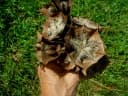
Abroma augustum
Abroma augustum
Safety & Hazards
The plant has irritating hairs[1].
Cultivation Details
A plant of the tropics, where it is found at elevations up to 1,200 metres. It grows best in areas where annual daytime temperatures are within the range 26 - 31°c, but can tolerate 18 - 36°c[2].It prefers a mean annual rainfall in the range 1,500 - 3,000mm, but tolerates 1,300 - 3,500mm, and dislikes marked dry seasons[2]. Requires a sunny position[2]. Succeeds in most soils, so long as they are well-drained, growing best in a fertile, medium loam[2]. Prefers a pH in the range 5 - 6, tolerating 4.5 - 6.5[2]. For the best quality fibre, the plant should be harvested when the flowers open - after about 100 - 120 days of growth[2]. The plant yields three crops a year, and is said to be more easily cultivated than jute (Corchorus spp.) or sunn hemp (Crotalaria juncea)[3].
Propagation
Seed - Cite as: Tropical Plants Database, Ken Fern. tropical.theferns.info. 2026-02-19. <tropical.theferns.info/viewtropical.php?id=Abroma+augustum>
Pollinators
Data unavailable
References
- [1]Plants and People of Nepal — Manandhar. N. P. · Timber Press. Oregon. · 2002 · ISBN 0-88192-527-6 ↩︎Excellent book, covering over 1,500 species of useful plants from Nepal together with information on the geography and peoples of Nepal. Good descriptions of the plants with terse notes on their uses.
- [2]Ecocrop — http://ecocrop.fao.org/ecocrop/srv/en/home ↩︎Basic information on a wide range of useful plants, plus details of environmental needs where available.
- [3]Useful Fiber Plants of the World — Dodge C.R. · USDA; Washington. · 1897 · http://www.biodiversitylibrary.org/ ↩︎A rather dated, but very comprehensive catalogue of fibre plants from around the world. The book can be downloaded from the Internet.
- [4]Flowers of India — http://www.flowersofindia.net/ ↩︎A wed site of native Indian plants, plus cultivated and naturalized species. It has good quality photos and terse details on more than 3,000 species and cultivars.
- [5]Flora of China — Missouri Botanical Garden Press; St. Louis. · 1994 · http://flora.huh.harvard.edu/china/ ↩︎An excellent, comprehensive resource in 25 volumes. In addition to the botanical information the flora also gives basic information on habitat and some uses. An on-line version is also available.
- [6]Mansfeld's Database of Agricultural and Horticultural Plants — http://mansfeld.ipk-gatersleben.de/pls/htmldb_pgrc/f?p=185:3:4292127278597336 ↩︎Terse details of a huge range of useful plants.
- [7]Dictionary of Economic Plants. — Uphof. J. C. Th. · Weinheim · 1959 · ISBN - ↩︎An excellent and very comprehensive guide but it only gives very short descriptions of the uses without any details of how to utilize the plants. Not for the casual reader.