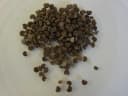
Abelmoschus moschatus
Abelmoschus moschatus
Safety & Hazards
None known
Cultivation Details
A plant of the tropics and subtropics, where it is found at elevations up to 1,100 metres, it is also cultivated in warm temperate areas. It grows best in areas where annual daytime temperatures are within the range 20 - 30°c, but can tolerate 10 - 35°c[1]. It prefers a mean annual rainfall in the range 1,000 - 1,400mm, but tolerates 900 - 1,500mm[1]. The plant is not hardy in the colder areas of the temperate zone, it can tolerate occasional temperatures down to about -5°c[2]. The plant is usually cut back to the ground in winter, but so long as these winters are not too cold it will usually resprout freely freely from the root-stock when warm weather returns. Easily grown in most rich, well-drained soils in a sunny position[2, 3]. Prefers a pH in the range 5.5 - 7, tolerating 5 - 8[1]. It is probably wise to apply a good mulch to the roots in the autumn[PFAF]. It is best to cut back the stems to about 15cm long in the spring even if they have not been killed back by the frost[2]. This will ensure an abundance of new growth and plenty of flowers in the summer. There is at least one named form, selected for its ornamental value. 'Mischief' is somewhat smaller than the species, reaching a height of 50cm[2].
Propagation
Seed - sow spring in a greenhouse. The seed germinates best at a temperature around 24 - 24°c[2]. When large enough to handle, prick out the seedlings into individual pots of rich soil and plant them out after the last expected frosts[PFAF]. The seed can also be sown in situ in late mid spring in areas with warm summers. Cuttings of half-ripe wood, July in a frame[2]. Cite as: Temperate Plants Database, Ken Fern. temperate.theferns.info. 2026-02-20. <temperate.theferns.info/plant/Abelmoschus+moschatus>
Pollinators
Insects
References
- [1]Ecocrop — http://ecocrop.fao.org/ecocrop/srv/en/home ↩︎Basic information on a wide range of useful plants, plus details of environmental needs where available.
- [2]Encyclopaedia of Herbs and their Uses. — Bown. D. · Dorling Kindersley, London. · 1995 · ISBN 0-7513-020-31 ↩︎A very well presented and informative book on herbs from around the globe. Plenty in it for both the casual reader and the serious student. Just one main quibble is the silly way of having two separate entries for each plant.
- [3]World Agroforesty Centre — http://www.worldagroforestry.org/ ↩︎An excellent online database of a huge range of trees giving very good information on each plant - its uses, ecology, identity, propagation, pests etc.
- [4]Flora of China — Missouri Botanical Garden Press; St. Louis. · 1994 · http://flora.huh.harvard.edu/china/ ↩︎An excellent, comprehensive resource in 25 volumes. In addition to the botanical information the flora also gives basic information on habitat and some uses. An on-line version is also available.
- [5]Plant Resources of Southeast Asia — http://proseanet.org/ ↩︎Lots of information on the uses of the plants of SE Asia.
- [6]Pacific Island Ecosystems at Risk — http://www.hear.org/pier/scientificnames/index.html ↩︎A very good website detailing weed species that have been introduced into the Pacific Islands.
- [7]Plants and People of Nepal — Manandhar. N. P. · Timber Press. Oregon. · 2002 · ISBN 0-88192-527-6 ↩︎Excellent book, covering over 1,500 species of useful plants from Nepal together with information on the geography and peoples of Nepal. Good descriptions of the plants with terse notes on their uses.
- [8]Cornucopia - A Source Book of Edible Plants. — Facciola. S. · Kampong Publications · 1990 · ISBN 0-9628087-0-9 ↩︎Excellent. Contains a very wide range of conventional and unconventional food plants (including tropical) and where they can be obtained (mainly N. American nurseries but also research institutes and a lot of other nurseries from around the world.
- [9]A Modern Herbal. — Grieve. · Penguin · 1984 · ISBN 0-14-046-440-9 ↩︎Not so modern (1930's?) but lots of information, mainly temperate plants.
- [10]Medicinal Plants of the Guianas — DeFilipps, R. A.; Maina, S. L.; & Crepin, J. · Smithsonian Museum · http://botany.si.edu/bdg/medicinal/index.html ↩︎A down-loadable PDF document of a book in pre-publication awaiting illustration. An excellent, if rather terse, guide to the traditional medicinal uses of the plants of the region
- [11]Glossary of Indian Medicinal Plants (Including the Supplement). — Chopra. R. N., Nayar. S. L. and Chopra. I. C. · Council of Scientific and Industrial Research, New Delhi. · 1986 · ISBN - ↩︎Very terse details of medicinal uses of plants with a wide range of references and details of research into the plants chemistry. Not for the casual reader.
- [12]CosIng — http://ec.europa.eu/growth/tools-databases/cosing/ ↩︎CosIng is the European Commission database for information on cosmetic substances and ingredients.
- [13]Dictionary of Economic Plants. — Uphof. J. C. Th. · Weinheim · 1959 · ISBN - ↩︎An excellent and very comprehensive guide but it only gives very short descriptions of the uses without any details of how to utilize the plants. Not for the casual reader.
- [PFAF]Plants for a Future — pfaf.org ↩︎