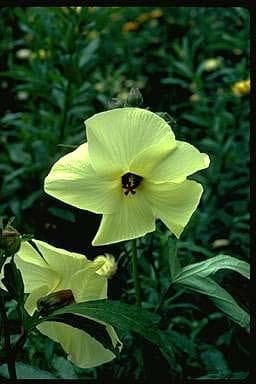
Abelmoschus manihot
Abelmoschus manihot
Safety & Hazards
None known
Cultivation Details
Abelmoschus manihot grows well in lowland tropical areas, with yields beginning to drop when they are grown at elevations above 500 metres. Theys may develop an annual habit of growth at higher elevations and in cooler climates[1]. They are generally tender in the temperate zone but can be grown outdoors as an annual, flowering well in their first year and setting seed[2, PFAF]. They will occasionally overwinter in a cold greenhouse in the temperate zone[PFAF]. Plants have a high moisture requirement and grow best in areas with an evenly distributed annual precipitation of 1,000mm or more[1]. They prefer a relatively high humidity and a stable temperature above 25°c, though they can tolerate occasional short-lived lows down to about -5°c so long as they are in a very well-drained soil[3, 1]. Easily grown in any well-drained soil in a sunny position[2]. Plants are most productive when grown in well-prepared fertile soils that are rich in organic matter[1]. When well looked after, the plant can be highly productive - yields of 40 - 60 tonnes per hectare have been achieved in the tropics[4, 1]. A very variable plant[1]. Plants do not flower well when day length is less than 12 hours[1]. Plants are somewhat susceptible to root nematodes[4]. It grows well in an ornamental vegetable garden[2].
Propagation
Seed - sow early spring in a warm greenhouse. The seed should germinate with two weeks, when it is large enough to handle prick it out into individual pots and plant out after the last expected frosts. The seed can also be sown in situ in late mid spring in areas with warm summers and a growing season of at least 6 months. Cite as: Temperate Plants Database, Ken Fern. temperate.theferns.info. 2026-02-20. <temperate.theferns.info/plant/Abelmoschus+manihot>
Pollinators
Insects
References
- [1]Vegetables in the Tropics — Tindall. H. D. · MacMillan, Oxford. · 1983 · ISBN 0-333-24268-8 ↩︎An excellent, in-depth look at the main vegetable crops that can be grown in the Tropics, plus many less well-known plants.
- [2]The New RHS Dictionary of Gardening. 1992. — Huxley. A. · MacMillan Press · 1992 · ISBN 0-333-47494-5 ↩︎Excellent and very comprehensive, though it contains a number of silly mistakes. Readable yet also very detailed.
- [3]Conservatory and Indoor Plants Volumes 1 & 2 — Phillips. R. & Rix. M. · Pan Books, London. · 1998 · ISBN 0-330-37376-5 ↩︎Excellent photos of over 1,100 species and cultivars with habits and cultivation details plus a few plant uses. Many species are too tender for outdoors in Britain though there are many that can be grown outside.
- [4]Edible Leaves of the Tropics — Martin. F. W.; Ruberte. R. M. & Meitzner. L. S. · Echo. USA. · 1998 · ISBN 0-9653360-1-8 ↩︎A terse guide, giving reasonable detail on the more common leaf crops and brief information on a wide range of lesser known plants.
- [5]Plants and People of Nepal — Manandhar. N. P. · Timber Press. Oregon. · 2002 · ISBN 0-88192-527-6 ↩︎Excellent book, covering over 1,500 species of useful plants from Nepal together with information on the geography and peoples of Nepal. Good descriptions of the plants with terse notes on their uses.
- [6]Flora of China — Missouri Botanical Garden Press; St. Louis. · 1994 · http://flora.huh.harvard.edu/china/ ↩︎An excellent, comprehensive resource in 25 volumes. In addition to the botanical information the flora also gives basic information on habitat and some uses. An on-line version is also available.
- [7]Cornucopia - A Source Book of Edible Plants. — Facciola. S. · Kampong Publications · 1990 · ISBN 0-9628087-0-9 ↩︎Excellent. Contains a very wide range of conventional and unconventional food plants (including tropical) and where they can be obtained (mainly N. American nurseries but also research institutes and a lot of other nurseries from around the world.
- [8]Glossary of Indian Medicinal Plants (Including the Supplement). — Chopra. R. N., Nayar. S. L. and Chopra. I. C. · Council of Scientific and Industrial Research, New Delhi. · 1986 · ISBN - ↩︎Very terse details of medicinal uses of plants with a wide range of references and details of research into the plants chemistry. Not for the casual reader.
- [9]Inventory of Seeds and Plants Imported Vol. 23 — USDA Government Printing Office; Washington DC. · 1911 · http://www.biodiversitylibrary.org ↩︎Details of seeds imported for trials by the United States Department of Agriculture in the second quarter of 1909, often detailing the uses of the plant and various other miscellaneous information. It can be downloaded from the Internet.
- [10]Oil Yielding Plants — Botanical Survey of India. · 2004 · http://mnes.nic.in/list/oil-plants.pdf ↩︎A PDF downloaded from the Internet. Very terse details about the applications of oil obtained from over 300 species of plants.
- [11]CosIng — http://ec.europa.eu/growth/tools-databases/cosing/ ↩︎CosIng is the European Commission database for information on cosmetic substances and ingredients.
- [PFAF]Plants for a Future — pfaf.org ↩︎