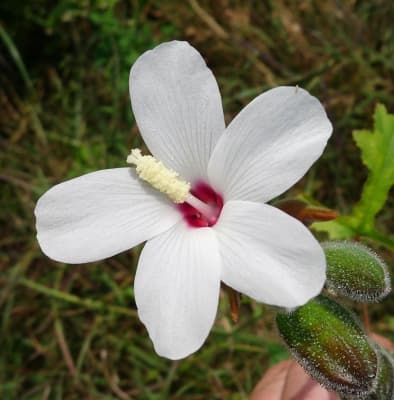
Malvaceae FAMILY Least Concern
Abelmoschus ficulneus
Abelmoschus ficulneus
Edibility
2/5
Medicinal
2/5
Safety & Hazards
None known
Cultivation Details
HabitAnnual
Growth—
A plant of low to moderate elevations, growing from near sea level to 1,350 metres. It is found mainly in areas with a distinct dry season[1]. The plant thrives luxuriantly with little or no care, yet is very little cultivated for its fibre[2]. The seed is sown in beds in May, and when the plants are 15cm tall they are set out in rows 22cm apart each way. The luxuriant growth and habits of the plant commend it to serious attention[2].
Propagation
Seed - it can be sown in situ, or in a nursery seedbed and planted out when 15 - 25cm tall. Cite as: Tropical Plants Database, Ken Fern. tropical.theferns.info. 2026-02-19. <tropical.theferns.info/viewtropical.php?id=Abelmoschus+ficulneus>
Pollinators
Data unavailable
References
- [1]IUCN Red List of Threatened Species — http://www.iucnredlist.org/ ↩︎A list of plants under threat and facing possible extinction, usually with brief details of the threats and information on habitat.
- [2]Useful Fiber Plants of the World — Dodge C.R. · USDA; Washington. · 1897 · http://www.biodiversitylibrary.org/ ↩︎A rather dated, but very comprehensive catalogue of fibre plants from around the world. The book can be downloaded from the Internet.
- [3]Protabase - Plant Resources of Tropical Africa. — http://www.prota.org ↩︎An excellent on-line database with detailed information on over 3,200 species of useful plants of Africa.
- [4]The Useful Plants of West Tropical Africa. — Burkil. H. M. · Royal Botanic Gardens; Kew. · 1985 - 2004 ↩︎Brief descriptions and details of the uses of over 4,000 plants. A superb, if terse, resource, it is also available electronically on the Web - see http://www.aluka.org/
- [5]Cornucopia II — Facciola. S. · Kampong Publications, California. · 1998 · ISBN 0-9628087-2-5 ↩︎The second edition of an excellent guide to the edible uses of plants, though it does not give any details of cultivation etc.
- [6]Economic Products of India. Volume 1. — Watt. G. · Government of India: Calcutta. · 1883 ↩︎Although over 100 years old, it still contains a wealth of information on useful plants. Many of the botanical names have been changed since then, so you have to check for up to date names. The book can be downloaded from the Internet.