Persoonia — 15 species
Botanical species in the genus Persoonia recorded in the PlantPeers database.

Persoonia acerosa
Persoonia acerosa
Family: Proteaceae
Cultivation
We have very little information on this species and do not know how hardy it will be in Britain. Plants tolerate temperatures down to at least -7°c in Australian gardens, though this cannot be translated directly to British gardens due to our cooler summers and longer colder and wetter winters. This species hybridises sporadically in the wild with P. levis and P. myrtilloides.
Full cultivation guide →Persoonia arborea
Persoonia arborea
Family: Proteaceae
Cultivation
We have very little information on this species and do not know how hardy it will be in Britain. It is a slow growing species. The following notes are based on the general needs of the genus.
Full cultivation guide →Persoonia chamaepeuce
Persoonia chamaepeuce
Family: Proteaceae
Cultivation
Requires a warm position in full sun in a freely draining preferably sandy slightly acid soil, preferring a pH around 6.3 to 6.5. Soils should be low in nutrients, especially nitrates and phosphates. Plants are not very hardy outdoors in Britain and usually require cool greenhouse treatment.
Full cultivation guide →Persoonia curvifolia
Persoonia curvifolia
Family: Proteaceae
Cultivation
We have very little information on this species and do not know how hardy it will be in Britain. Plants tolerate temperatures down to at least -7°c in Australian gardens, though this cannot be translated directly to British gardens due to our cooler summers and longer colder and wetter winters. Persoonia curvifolia hybridises with P. linearis and P. sericea where they grow together.
Full cultivation guide →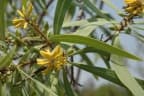
Persoonia falcata
Persoonia falcata
Family: Proteaceae
Cultivation
A plant of the lowland tropics, where it is found at elevations up to 900 metres. It grows best in areas where annual daytime temperatures are within the range 22 - 38°c, but can tolerate 2 - 41°c. It prefers a mean annual rainfall in the range 600 - 1,400mm, but tolerates 450 - 1,750mm.
Full cultivation guide →Persoonia fastigiata
Persoonia fastigiata
Family: Proteaceae
Cultivation
We have very little information on this species and do not know how hardy it will be in Britain. Plants tolerate temperatures down to at least -7°c in Australian gardens, though this cannot be translated directly to British gardens due to our cooler summers and longer colder and wetter winters. Persoonia fastigiata hybridises extensively with P. cornifolia where they grow together, forming hybrid swarms.
Full cultivation guide →Persoonia gunnii
Persoonia gunnii
Family: Proteaceae
Cultivation
We have very little information on this species and do not know how hardy it will be in Britain. The following notes are based on the general needs of the genus. Requires a warm position in full sun in a freely draining preferably sandy slightly acid soil, preferring a pH around 6.3 to 6.5.
Full cultivation guide →Persoonia juniperina
Persoonia juniperina
Family: Proteaceae
Cultivation
We have very little information on this species and do not know how hardy it will be in Britain. The following notes are based on the general needs of the genus. Requires a warm position in full sun in a freely draining preferably sandy slightly acid soil, preferring a pH around 6.3 to 6.5.
Full cultivation guide →Persoonia levis
Persoonia levis
Family: Proteaceae
Cultivation
Requires a warm position in full sun in a freely draining preferably sandy slightly acid soil, preferring a pH around 6.3 to 6.5. Soils should be low in nutrients, especially nitrates and phosphates. Plants are not very hardy outdoors in Britain and usually require cool greenhouse treatment.
Full cultivation guide →Persoonia linearis
Persoonia linearis
Family: Proteaceae
Cultivation
Requires a warm position in full sun in a freely draining preferably sandy slightly acid soil, preferring a pH around 6.3 to 6.5. Soils should be low in nutrients, especially nitrates and phosphates. Plants are not very hardy outdoors in Britain and usually require cool greenhouse treatment.
Full cultivation guide →Persoonia mollis
Persoonia mollis
Family: Proteaceae
Cultivation
We have very little information on this species and do not know how hardy it will be in Britain. Plants tolerate temperatures down to at least -7°c in Australian gardens, though this cannot be translated directly to British gardens due to our cooler summers and longer colder and wetter winters. Persoonia mollis is a complex species exhibiting considerable geographic variation, represented formally by 9 subspecies.
Full cultivation guide →Persoonia oxycoccoides
Persoonia oxycoccoides
Family: Proteaceae
Cultivation
We have very little information on this species and do not know how hardy it will be in Britain. Plants tolerate temperatures down to at least -7°c in Australian gardens, though this cannot be translated directly to British gardens due to our cooler summers and longer colder and wetter winters. Some botanists treat this plant as no more than a sub-species of P. nutans.
Full cultivation guide →Persoonia pinifolia
Persoonia pinifolia
Family: Proteaceae
Cultivation
Requires a warm position in full sun in a freely draining preferably sandy slightly acid soil, preferring a pH around 6.3 to 6.5. Soils should be low in nutrients, especially nitrates and phosphates. Resists salt spray.
Full cultivation guide →Persoonia rigida
Persoonia rigida
Family: Proteaceae
Cultivation
Requires a warm position in full sun in a freely draining preferably sandy slightly acid soil, preferring a pH around 6.3 to 6.5. Soils should be low in nutrients, especially nitrates and phosphates. Plants are not very hardy outdoors in Britain and usually require cool greenhouse treatment.
Full cultivation guide →Persoonia subvelutina
Persoonia subvelutina
Family: Proteaceae
Cultivation
We have very little information on this species and do not know how hardy it will be in Britain. The following notes are based on the general needs of the genus. Requires a warm position in full sun in a freely draining preferably sandy slightly acid soil, preferring a pH around 6.3 to 6.5.
Full cultivation guide →